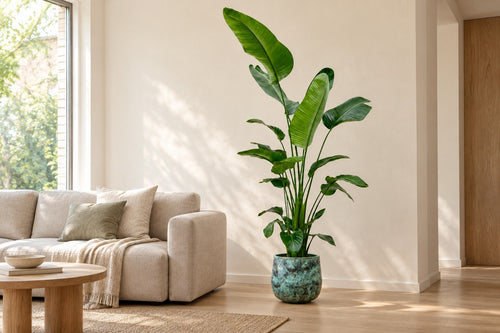
Japandi houseplants suit a blend of Japanese and Scandinavian interiors, with clean shapes such as fiddle leaf fig, snake plant, dragon tree and Ficus Ginseng. Put them in a plain pot made of clay, stone or rattan.
Japandi blends Japanese minimalism with the simplicity of Scandinavian living. You see few belongings, natural materials and lots of space. Plants play a big part in that, but preferably one large plant with a clear shape rather than a windowsill full of small pots. Think of large, sturdy leaves, a graphic growth habit or a trunk with character. Prefer a lighter, more Nordic feel? Have a look at the Scandinavian plants.
Which plant to choose
Ficus lyrata, the fiddle leaf fig: large, wavy leaves. From an 80 cm bush to a 270 cm tree, also branched or as a standard.
Dracaena marginata: narrow leaves on thin, curved trunks, in 180 and 220 cm. You will find more species under Dracaena.
Sansevieria: crisp, upright leaves 100 to 110 cm tall.
Ficus microcarpa 'Ginseng': 80 cm, with a thick root trunk in bonsai form.
Braided Ficus and a 200 cm Ficus benghalensis, for anyone after a true tree shape.
Parlour palm (Chamaedorea elegans) of 100 cm, a softer shape for a bright corner.
Light and care
Most plants in this collection like partial shade. They prefer a bright spot, without harsh midday sun on the leaves. The Ficus lyrata wants plenty of indirect light and a permanent spot. Try not to move it too often, as it may drop leaves. Read more in our Ficus care guide. The Sansevieria copes with less light and needs little water. Water the other plants when the top layer of potting soil feels dry.
Styling the Japandi way
Give one plant room and keep the space around it sparse. Choose a decorative pot in a matt, natural colour, such as sand, grey or black, or a pot made of clay or stone. A low wooden bench or stool under a smaller plant works well. Your plant comes in a nursery pot, so you choose the decorative pot separately. For a high ceiling you will find large specimens among the XXL plants.
Delivery
In the Netherlands your plant arrives in 4 to 5 working days, upright in a sturdy plant box. Delivery within the Netherlands is free from €99. If anything is damaged on the way, send us a photo and we will send you a new plant free of charge.
Plants with a calm, clear shape suit it best. Think of a Ficus lyrata with large leaves, a Dracaena marginata with thin trunks, a crisp Sansevieria or a Ficus 'Ginseng' in bonsai form. Choose one large plant rather than many small ones.
What is a Japanese houseplant?
By a Japanese houseplant people often mean a plant with a bonsai shape or a sober, graphic growth habit. In this collection the Ficus microcarpa 'Ginseng', with its thick root trunk, comes closest. A braided Ficus also fits that look.
Which Japandi plant copes with low light?
The Sansevieria, also known as snake plant, copes with less light than most houseplants and needs little water. A Ficus lyrata, on the other hand, wants plenty of indirect light, so put it close to a window.
How much light does a Ficus lyrata need?
A Ficus lyrata wants a bright spot with plenty of indirect light, for example a metre or two from a large window. Harsh midday sun on the leaves is too much. Give it a permanent spot, because it sometimes drops leaves after being moved.
Which pot suits a Japandi plant?
A matt pot in a natural colour suits it best, such as sand, grey, black or a pot made of clay or stone. Keep the shape simple, without a bold print. The plant comes in a nursery pot, so you choose the decorative pot yourself.